Announcement

Collapse
No announcement yet.

Tik Pipe kit Roadster 82cv

Collapse
X
 
  • Filter
  • Time
  • Show
Clear All
new posts

  • Tik Pipe kit Roadster 82cv

    I'm in the same dilemma for my Roadster 82CV remapped.
    I do not know which kits tik choose:
    Brabus Tik 74kw
    Forge Kit
    Tradetec Kit

    After this time, any new opinion?

  • #2
    Re: Tik Pipe kit Roadster 82cv

    I need to replace my stock tik pipe ad its damaged, i think for the small difference in price in going to upgrade to a brabus one.

    Cant see it being worth the extra for a silicone one unless you want it to look pretty, performance wise i wouldn't imagine there would be much if any difference

    Comment


    • #3
      Re: Tik Pipe kit Roadster 82cv

      Silicone TIK pipe gives poorer performance because their shape is not tailored to suit turbo. It is to do with the air flow. Same applies when fitting larger bore TIK than standard unless turbo is also changed to suit.

      Comment


      • #4
        Re: Tik Pipe kit Roadster 82cv

        Tradetec imports chinese slicon hoses...
        Big and Smart-Stuff have our hoses made in the UK
        Together we have sold lots of kits to lots of customers worldwide.
        Not one has complained that there is no increase in performance


        Tolsen had his own opinion about performance gains.
        Www.BigPerformance.Co.Uk

        020 328 REMAP (02032873627)
        07702948467
        STAR diagnostics. Remapping. Dyno. Key coding
        TAN codes. SCN codes. Body shop. Trimming. Crash repairs

        Comment


        • #5
          Re: Tik Pipe kit Roadster 82cv

          So, do you recomend it ?

          Originally posted by Big Performance View Post
          Tradetec imports chinese slicon hoses...
          Big and Smart-Stuff have our hoses made in the UK
          Together we have sold lots of kits to lots of customers worldwide.
          Not one has complained that there is no increase in performance


          Tolsen had his own opinion about performance gains.

          Comment


          • #6
            Re: Tik Pipe kit Roadster 82cv

            Go for standard Brabus or the Forge TIK.
            They are the 2 I have tried with the best fitting.

            The cheap Chinese imports are copies of the Forge gear and you can see where they have cut the costs.

            Comment


            • #7
              Re: Tik Pipe kit Roadster 82cv

              I have my old Brabus TIK pipe if you need you one for cheap sir

              Comment


              • #8
                Re: Tik Pipe kit Roadster 82cv

                Jorge, of course I recommend our silicon hoses, not Forge as they are also made in China.
                Either buy through me or Smart-Stuff.
                Www.BigPerformance.Co.Uk

                020 328 REMAP (02032873627)
                07702948467
                STAR diagnostics. Remapping. Dyno. Key coding
                TAN codes. SCN codes. Body shop. Trimming. Crash repairs

                Comment


                • #9
                  Re: Tik Pipe kit Roadster 82cv

                  Originally posted by bazza. View Post
                  I have my old Brabus TIK pipe if you need you one for cheap sir
                  How much u looking for?

                  Comment


                  • #10
                    Re: Tik Pipe kit Roadster 82cv

                    450 Inlet Duct Losses. (First published 18 May 2013).

                    Is there any performance improvement by fitting substandard free flowing air filters, de-lip your external air intake or change existing TIK pipe for a larger or perhaps one with a smoother bore?

                    The answer is of course that the improvement is very very small, negligible at the most.

                    The stock inlet air duct is well designed and tuned to the engine. Tampering with it is more likely to result in poorer performance, poorer filtration and greater risk of suffering irreversible damage to engine due to air leaks and ingress of unfiltered dirty air.

                    Proving the above is surprisingly simple. One only needs to measure vacuum in inlet duct just before turbo at various engine loads and calculate the losses. Strange nobody has done it before.

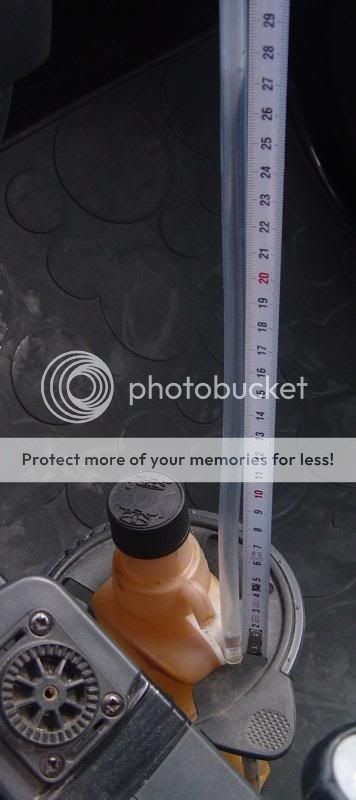
                    Please don't laugh but above is a scientific instrument or a manometer. It measures vacuum (in mm H2O) in TIK pipe on my 450 Cdi at the point where breather pipe from engine normally connects. This is just in front of turbo compressor housing. Vacuum at idle is recorded in above photo, approximately 15 mm H2O.

                    Here is my elegant proof:
                    Have measured vacuums in inlet duct just in front of turbo compressor on my stock unmodified inlet air duct system with stock paper filter fitted. Measured vacuums during normal driving 6th gear/ 1800 rpm and when driving flat out in 5th gear up a steep hill at 3000 rpm.
                    Vacuums during normal driving averaged 50 mm water gauge. Flat out vacuum was 210 mm water gauge. I have previously proved that vacuums with more free flowing filters will be slightly higher so won't dwell on that now.

                    Here is the elegant bit. Using the vacuums measured I calculate the corresponding engine power loss (0 mm vacuum gives nil power loss):

                    Normal driving, level road, 6th gear at 1800 rpm. Vacuum 50 mm. Ambient 14C. IAT 23C. Turbo boost 0.4 bar.
                    Calculated power loss due to vacuum in air intake before turbo becomes 6 Watt or 0.008 HP.

                    Driving flat out up a hill in 5th gear at 3000 rpm. Vacuum 210 mm. Ambient 14C. IAT 45C. Turbo boost 1.1 bar.
                    Calculated power loss due to vacuum in air intake before turbo becomes 60 Watt or 0.081 HP.

                    Power loss [Watt] equals vacuum in TIK [Pascal] times the free air flow [m3 per second].
                    W = J/s = Nm/s = N/m2 x m3/s = Pa x m3/s

                    Free air flow was calculated for the OM660 engine assuming a 75% engine volumetric efficiency, turbo compressor efficiency 75% and charge cooler efficiency 66%.

                    Removing the disc over the air intake will reduce the losses by approximately 30%. A further reduction may be achieved by fitting expensive smooth bore TIK pipe but turbocharger performance and life are adversely affected if the appropriate air intake TIK pipe matched to the turbo is not used. TIK pipe is designed to provide proper air flow pattern ahead of the turbocharger. "Upgrading" to a larger bore or one of these poorly made silicon TIK pipes is therefore not advisable. Free flow air filters will probably increase the losses.

                    Anyway, since the power losses in the stock air intake are so small, some of you may appreciate that there is very little scope for improving performance by modifying or tampering with the stock system.

                    Q.E.D.

                    Comment


                    • #11
                      Re: Tik Pipe kit Roadster 82cv

                      Originally posted by tolsen View Post
                      450 Inlet Duct Losses. (First published 18 May 2013).

                      Is there any performance improvement by fitting substandard free flowing air filters, de-lip your external air intake or change existing TIK pipe for a larger or perhaps one with a smoother bore?

                      The answer is of course that the improvement is very very small, negligible at the most.

                      The stock inlet air duct is well designed and tuned to the engine. Tampering with it is more likely to result in poorer performance, poorer filtration and greater risk of suffering irreversible damage to engine due to air leaks and ingress of unfiltered dirty air.

                      Proving the above is surprisingly simple. One only needs to measure vacuum in inlet duct just before turbo at various engine loads and calculate the losses. Strange nobody has done it before.

                      Please don't laugh but above is a scientific instrument or a manometer. It measures vacuum (in mm H2O) in TIK pipe on my 450 Cdi at the point where breather pipe from engine normally connects. This is just in front of turbo compressor housing. Vacuum at idle is recorded in above photo, approximately 15 mm H2O.

                      Here is my elegant proof:
                      Have measured vacuums in inlet duct just in front of turbo compressor on my stock unmodified inlet air duct system with stock paper filter fitted. Measured vacuums during normal driving 6th gear/ 1800 rpm and when driving flat out in 5th gear up a steep hill at 3000 rpm.
                      Vacuums during normal driving averaged 50 mm water gauge. Flat out vacuum was 210 mm water gauge. I have previously proved that vacuums with more free flowing filters will be slightly higher so won't dwell on that now.

                      Here is the elegant bit. Using the vacuums measured I calculate the corresponding engine power loss (0 mm vacuum gives nil power loss):

                      Normal driving, level road, 6th gear at 1800 rpm. Vacuum 50 mm. Ambient 14C. IAT 23C. Turbo boost 0.4 bar.
                      Calculated power loss due to vacuum in air intake before turbo becomes 6 Watt or 0.008 HP.

                      Driving flat out up a hill in 5th gear at 3000 rpm. Vacuum 210 mm. Ambient 14C. IAT 45C. Turbo boost 1.1 bar.
                      Calculated power loss due to vacuum in air intake before turbo becomes 60 Watt or 0.081 HP.

                      Power loss [Watt] equals vacuum in TIK [Pascal] times the free air flow [m3 per second].
                      W = J/s = Nm/s = N/m2 x m3/s = Pa x m3/s

                      Free air flow was calculated for the OM660 engine assuming a 75% engine volumetric efficiency, turbo compressor efficiency 75% and charge cooler efficiency 66%.

                      Removing the disc over the air intake will reduce the losses by approximately 30%. A further reduction may be achieved by fitting expensive smooth bore TIK pipe but turbocharger performance and life are adversely affected if the appropriate air intake TIK pipe matched to the turbo is not used. TIK pipe is designed to provide proper air flow pattern ahead of the turbocharger. "Upgrading" to a larger bore or one of these poorly made silicon TIK pipes is therefore not advisable. Free flow air filters will probably increase the losses.

                      Anyway, since the power losses in the stock air intake are so small, some of you may appreciate that there is very little scope for improving performance by modifying or tampering with the stock system.

                      Q.E.D.
                      Your experiment is interesting at best, but only valid as far as the OP is concerned if repeated with a petrol at 6000rpm and 1.4+ bar of boost, I think your conclusions might be different then.

                      Cheers!

                      Ps. even a modern normally aspirated car is more than 75% volumetric efficient, a tuned petrol 450 is closer to 100+%
                      Last edited by Kapt. Q; 11-02-14, 11:13 PM.

                      Comment


                      • #12
                        Re: Tik Pipe kit Roadster 82cv

                        Oh, what a wonderful can of worms we've opened here!

                        Tolsen, I don't fully follow your analysis, but I suspect you've made some gross errors somewhere. Firstly, why are your volumetric efficiency figures so low? Without throttling losses and no boost your diesel should be over 90% for the majority of the engine speed range. Add in the effects of the turbo and, please correct me if you think I'm wrong, shouldn't the volumetric efficiency be greater than 1 if you're using the pre-compressor figures for your calculations? I've probably missed something, so please help me out here.

                        The other thing I'm a little confused about is your comment on bigger or inappropriately shaped TIK pipes potentially causing damage to the turbo. Did you really mean that? If so, I'd love to understand. Please mix into the answer the comparative effect of causing compressor surge, or worse a stall when closing the throttle at full boost. I know you've a diesel, but humour me please.

                        Just for the record, I've a Forge TIK. Did it improve performance? No idea, but my original was cracked, and it seemed like a good idea at the time. What I do know is substituting a dirty OE air filter for a nice clean K&N made a massive world of difference to the performance. Have you measured the pressure drop across a filter before Tolsen? If you have I'd be interested in seeing the results and comparing them to what you've measured here.

                        Cheers... P
                        Last edited by tinwelp; 18-02-14, 08:17 PM.

                        Comment


                        • #13
                          Re: Tik Pipe kit Roadster 82cv

                          Thanks for the constructive criticism guys.

                          Reference to 75% engine volumetric efficiency (VE) in my previous post is a misprint. Actual VE was much higher. The method I used for estimating air flow was rather contorted in that I worked myself back the way from inlet manifold pressure to arrive at a free air flow estimate at air intake. One problem I was faced with was how to estimate VE. There will be a VE table for our engines stored somewhere in the MAP file but not so easy to lay may hands on it.

                          After some brainstorming I have figured out a much easier and more direct method of estimating air flow only requiring TIK pipe vacuum and ambient air temperature to be measured.

                          Using Bernoulli's principle one can arrive at following formula for free air flow volume:

                          Q=(π/2sqrt2)x(dxd/sqrtρ)x(sqrtΔp)

                          Where Q is free air flow volume, π is pi = 3.14, d is TIK pipe diameter in front of turbo where I measure vacuum, ρ is ambient air density and Δp is vacuum in TIK pipe.

                          Using above formula I have worked out below revised estimates of air flow and power losses. Previous published data is printed in italics:

                          Normal driving, level road, 6th gear at 1800 rpm. Vacuum 50 mm. Ambient 14C. IAT 23C. Turbo boost 0.4 bar.
                          Calculated power loss due to vacuum in air intake before turbo becomes 6 Watt or 0.008 HP.


                          Free air flow Q = 20 l/s (litres per second). Swept air flow 12 l/s. VE 167%. Power loss 10 Watt.

                          Driving flat out up a hill in 5th gear at 3000 rpm. Vacuum 210 mm. Ambient 14C. IAT 45C. Turbo boost 1.1 bar.
                          Calculated power loss due to vacuum in air intake before turbo becomes 60 Watt or 0.081 HP.


                          Free air flow Q = 41 l/s (litres per second). Swept air flow 20 l/s. VE 205%. Power loss 84 Watt.

                          So a slight increase but basically identical to the previously posted losses.

                          Tinwelp's query: Have you measured pressure drop across a filter before?
                          Answer: Yes, I have. See below link:

                          Comment


                          • #14
                            Re: Tik Pipe kit Roadster 82cv

                            A thorough analysis of pumping losses there TK. The thread, as it began though, centres around power production.
                            Ultimately, at higher rpm, there will be one dominant restriction in the induction system. It could be anywhere from the air intake on the outside of the car to the inlet valves and their timing (even the exhaust valves - ie back pressure).
                            That smart made different TIKs available suggests that the smallest (of three) available TIKs presents an obstruction when fitted to petrol engined fortwos. As the internals of a smart TIK are none too smooth (moulding flashes) and will give rise to turbulent flow at higher gas velocities, then it follows that a larger TIK will delay that transition to turbulent flow. Turbulent flow that will both impede air flow and create unfavourable entry conditions at the compressor.
                            Removing said roughness on any TIK is in my opinion worth doing, and having ran with the largest smart TIK, smoothed of flashes, for what now must be 45000 miles (current mileage 66000) and the turbo being in perfect health, I conclude that it causes no harm to the turbo whatsoever.

                            Comment


                            • #15
                              Re: Tik Pipe kit Roadster 82cv

                              Originally posted by Thrumbleux View Post
                              A thorough analysis of pumping losses there TK. The thread, as it began though, centres around power production.
                              Ultimately, at higher rpm, there will be one dominant restriction in the induction system. It could be anywhere from the air intake on the outside of the car to the inlet valves and their timing (even the exhaust valves - ie back pressure).
                              That smart made different TIKs available suggests that the smallest (of three) available TIKs presents an obstruction when fitted to petrol engined fortwos. As the internals of a smart TIK are none too smooth (moulding flashes) and will give rise to turbulent flow at higher gas velocities, then it follows that a larger TIK will delay that transition to turbulent flow. Turbulent flow that will both impede air flow and create unfavourable entry conditions at the compressor.
                              Removing said roughness on any TIK is in my opinion worth doing, and having ran with the largest smart TIK, smoothed of flashes, for what now must be 45000 miles (current mileage 66000) and the turbo being in perfect health, I conclude that it causes no harm to the turbo whatsoever.
                              I couldn't put it better myself, I have run a few 450's and a roadster in various levels of tune with various mods and experience tells me (as well as the dynometer) that you can do better than a stock TIK if you are trying to get more out of your engine. Brabus certainly thought this as does everyone in the fortwo race series. After over 100,000 miles in Smarts I have not had a turbo failure that was a result of a TIK change.

                              Cheers!
                              Last edited by Kapt. Q; 14-02-14, 03:49 PM.

                              Comment

                              Ad Widget

                              Collapse
                              Working...
                              X